
Exams are just 10 days away, your syllabus feels incomplete, confidence is low, and every study session ends with stress instead of progress. If this sounds like you, relax — this is normal, and more importantly, fixable.
The last 10 days are not about studying everything. They are about studying smart, locking memory, removing panic, and entering the exam hall with clarity and confidence.
This blog gives you a proven 10-day system used by high scorers to maximize marks even when preparation is not perfect.
In this blog, these 5 performance-boosting strategies are covered:
Low Confidence With Exams So Close? A 10-Day Revision System to Improve Marks
Syllabus Incomplete Before Final Exams? A 10-Day Catch-Up Study Plan
Wasting Time During the Last 10 Days? A High-Focus Routine for Exam Success
Too Much to Revise in Less Time? A Smart 10-Day Revision Framework
Still Forgetting What You Study? A 10-Day Memory-Focused Study Method
Let’s break everything down step by step.
1️⃣ Low Confidence With Exams So Close? A 10-Day Revision System to Improve Marks
Low confidence before exams doesn’t mean you are weak — it means your brain doesn’t know what is ready and what is not. Confidence comes from clarity, not motivation.
The Confidence Building Formula
Confidence = Familiar Questions + Repeated Success + Clear Targets
Daily Confidence Circuit (90 Minutes)
This short daily routine builds exam confidence very fast:
30 minutes: Previous Year Questions (easy & repeated ones)
30 minutes: Formula / diagram flashcards (around 40–50)
30 minutes: Short confidence test (questions you already know)
This tells your brain: “I can solve this.”
10-Day Confidence Growth Path
Days 1–3: Easy questions + familiar chapters → confidence starts rising
Days 4–6: Medium PYQs + error fixing → stability
Days 7–9: Full mock tests → exam readiness
Day 10: Light revision + visualization → calm confidence
Morning Confidence Ritual (5 Minutes)
Say out loud: “I am prepared and improving every day.”
Write 3 things you did well yesterday
Decide only 3 tasks for today (no overload)
📌 Result: Exam anxiety drops, silly mistakes reduce, accuracy improves.
2️⃣ Syllabus Incomplete Before Final Exams? A 10-Day Catch-Up Study Plan
Incomplete syllabus is the most common problem, not the worst one. The mistake students make is trying to finish everything instead of what matters.
The 80/20 Catch-Up Rule
80% marks come from 20% high-weightage chapters. That’s where your focus goes.
High-Priority Subject Breakdown (Example)
Maths: Core chapters that repeat every year
Science: Diagrams, numericals, and NCERT lines
SST: Key history chapters, maps, and definitions
English: Grammar + writing formats
Languages: Grammar + standard answers
Low-weightage chapters are revised only at a basic level.
Daily Catch-Up Structure
Morning (2 hrs): New or weak chapter (high priority)
Mid-day (2 hrs): PYQs from that chapter
Evening (1.5 hrs): Error correction + summary
Night (15 min): Flashcards only
3-Hour Chapter Mastery System
Hour 1: Understand (NCERT + 1.5x video)
Hour 2: Practice (PYQs + few new questions)
Hour 3: Recall + one-page summary
📌 Result: You don’t “finish” syllabus — you control it.
3️⃣ Wasting Time During the Last 10 Days? A High-Focus Routine for Exam Success

In the final days, time leaks silently — phone checks, thinking too much, switching subjects.
Step 1: Time Audit (Be Honest)
At the end of the day, write:
Planned study time
Actual study time
Where time was wasted
One fix for tomorrow
This alone saves 1–2 hours daily.
90-Minute Deep Focus Cycle
0–5 min: Desk reset + deep breathing
5–50 min: Deep study (no phone, no switching)
50–55 min: Walk or stretch
55–90 min: Second focus block
Two such cycles = more effective than 5 distracted hours.
Time-Waste Killers
Phone in another room
Only 3 items on desk (book, pen, water)
No notifications
Study material decided one day before
📌 Result: Daily productivity jumps without studying longer.
4️⃣ Too Much to Revise in Less Time? A Smart 10-Day Revision Framework
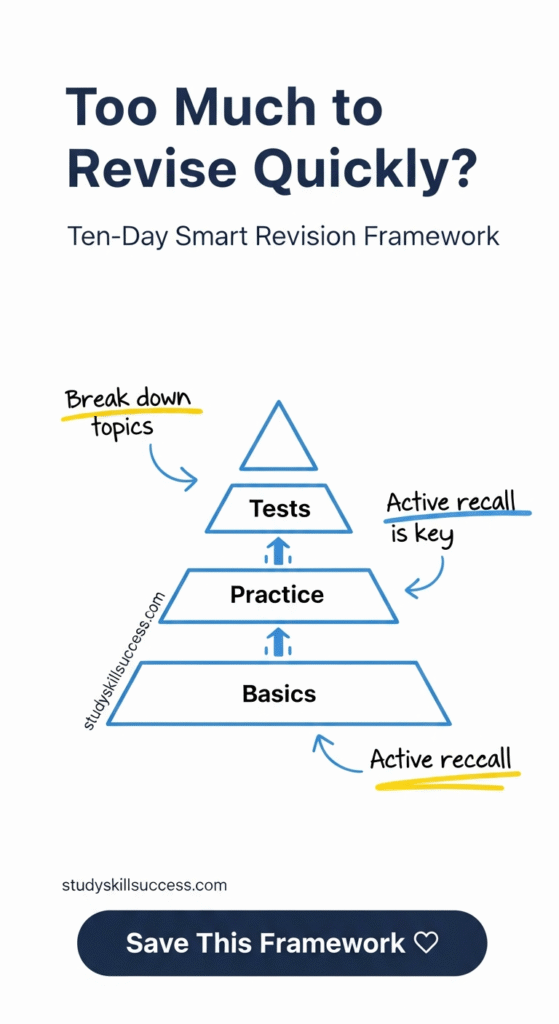
Revision is not re-reading books. It is testing memory under pressure.
The Smart Revision Pyramid
Top Priority: Previous year questions
Middle: Formula sheets & diagrams
Base: Error log + weak areas
Daily Revision Stack
Morning: One PYQ paper or chapter-wise PYQs
Afternoon: Mock test or timed practice
Evening: Flashcards + diagrams
Night: Audio revision while walking
Fast Revision Techniques
One-page summaries per chapter
Color coding (red = must know)
Recording formulas in your own voice
Quick quizzes with friends
📌 Result: You feel like you revised the full syllabus — without panic.
5️⃣ Still Forgetting What You Study? A 10-Day Memory-Focused Study Method
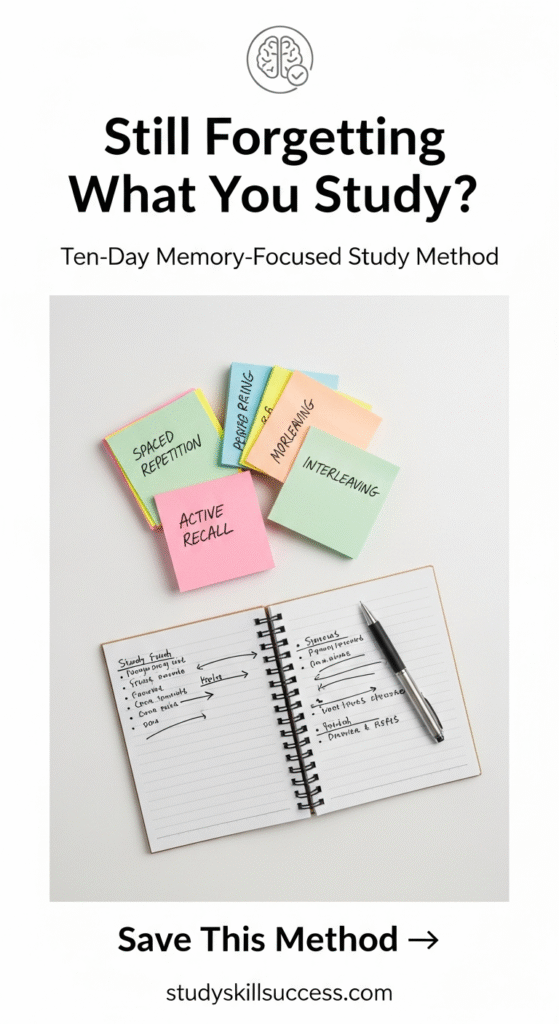
Forgetting is not failure. It’s a signal that your revision style is wrong.
The Forgetting Curve Fix
Use spaced repetition:
Day 1: Learn
Day 2: Recall
Day 4: Test
Day 7: Review
Day 9: Final lock
Memory Power Tools
Active recall: Close book, write from memory
Feynman technique: Explain in simple words
Mnemonics: Create funny memory hooks
Visual memory: Diagrams, maps, timelines
Teach-back: Explain to mirror or friend
Daily Memory Circuit (60 Minutes)
20 min: Recall test
20 min: Flashcards
20 min: Teaching aloud
📌 Result: Memory sticks till exam day.
Complete 10-Day Master Timetable (Example)
Days 1–2: Maths + Physics
Days 3–4: English + SST
Days 5–6: Chemistry + Biology + Language
Days 7–8: Full mock tests + analysis
Days 9–10: Formula sheets, diagrams, light review
Expected Score Transformation
Start: 65–75% (confused)
Day 5: 80–85% (stable)
Day 10: 90%+ (confident)
Final Truth
The last 10 days are not about miracles.
They are about direction, discipline, and calm execution.
Follow this plan honestly, and you won’t walk into the exam hall scared — you’ll walk in prepared.
Panic OFF. Confidence ON. Performance locked. 🔥📚