
Studying for long hours but still forgetting everything before the exam is one of the most frustrating problems students face today. Many students sit with books for 6–8 hours daily, yet their marks remain average and their confidence keeps dropping. The issue is not laziness or lack of effort — the real problem is using slow, outdated study methods.
This complete guide explains fast study hacks that convert wasted long hours into smart 2–3 hour sessions. These techniques are science-backed, practical, and proven to help you learn faster, remember more, finish the syllabus on time, and stay focused without burnout.
In this guide, you will learn:
How to replace passive reading with active learning
How to finish the syllabus using the 80/20 rule
How to study one chapter in under 90 minutes
How to stop forgetting what you study
How to build laser-level focus and study in half the time
This is a complete 2100+ word actionable blueprint designed for school and college students who want results, not just motivation.
1️⃣ Fast Study Tips: Studying Long Hours but Learning Less? Simple Techniques to Study Faster and Remember More
Why Long Study Hours Don’t Work
Most students use passive study methods:
Re-reading textbooks
Highlighting without thinking
Watching long videos without testing
Passive study gives only 20–25% retention, which means most of what you study is forgotten within 24 hours. That’s why exams feel blank even after long preparation.
The Solution: Active Learning Shift
Active learning increases retention up to 80–85% and cuts study time by more than half.
The Pomodoro + Recall Power Combo
Instead of sitting endlessly, use this structure:
25 minutes: Study actively (book closed, solve questions)
5 minutes: Walk, stretch, deep breathing
Repeat for 4 cycles
➡️ 2 hours of this method = 6–8 hours of normal study
5 Memory-Locking Techniques
1. Feynman Method
Explain the topic as if you are teaching a 5-year-old. If you get stuck, that’s your weak area.
2. Chunking
Break large chapters into 3 small parts (30 minutes each). Smaller goals = faster progress.
3. Visual Stories
Turn formulas into stories. Example: Distance = Speed × Time becomes “Speedy friend wasting time.”
4. Teach-Back Ritual
Explain concepts aloud to a mirror or imaginary student. Confidence and clarity double.
5. Sleep Encoding
Do a 10-minute recap before sleeping. The brain processes and stores information during sleep.
Daily Fast Study Circuit
6:00–7:00 AM: Morning Gold Hour (highest focus)
9:00–10:30 AM: Main Pomodoro session
7:00–8:00 PM: Flashcards + quick revision
Result: 90 minutes of active study beats 4 hours of passive reading.
2️⃣ Fast Study Method: Can’t Finish Syllabus on Time? Use This Proven Study System to Save Time and Boost Results
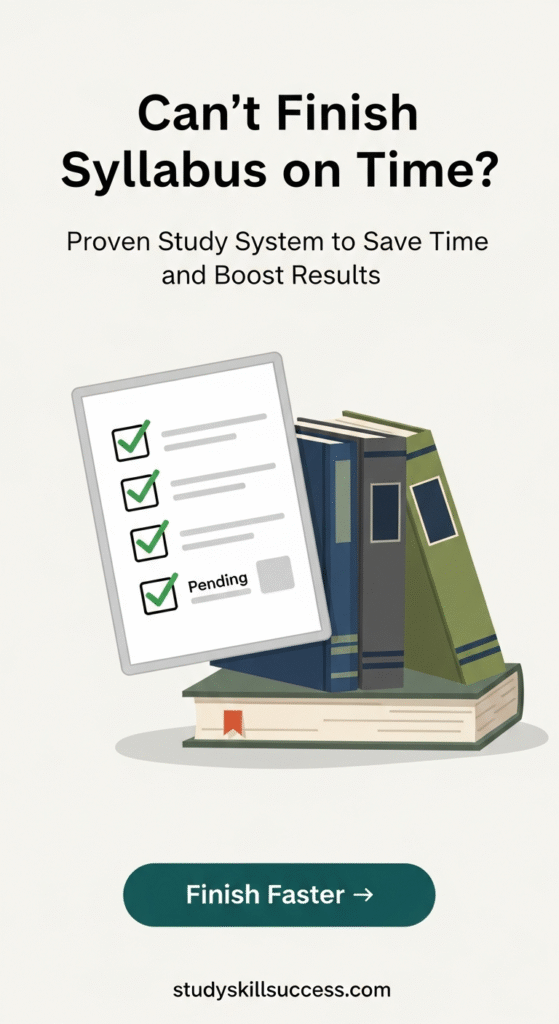
The 80/20 Rule (Pareto Principle)
In almost every exam, 80% of marks come from 20% of topics. Smart students identify and master these first.
High-Yield Topic Priority (Example)
Maths: Algebra, Triangles, Trigonometry
Science: Light, Electricity, Carbon Compounds, Life Processes
SST: Nationalism, Resources, Agriculture
English: Grammar + Letter Writing
3-Day Chapter Domination System
Day 1 – Understand
25 min NCERT reading
15 min concept video
Day 2 – Practice
25 previous-year questions
10 new practice questions
Day 3 – Test & Fix
Full chapter test
Error analysis and corrections
➡️ What normally takes 45 days, finishes in 12–15 days using this system.
Smart Skipping Rules
Low-weight chapters: Only formulas and definitions
Theory-heavy chapters: One-page mind map
Similar chapters: Combine into one session
Time Tracker Template
Track speed and efficiency:
Planned time vs actual time
Number of questions solved
Retention rating (1–10)
This prevents time leakage and boosts speed weekly.
3️⃣ Fast Studying: Taking Too Much Time on One Chapter? Smart Study Habits to Learn Quickly Without Stress
Top Time-Wasting Traps
Trap 1: Over-making Notes
Fix: Use the Cornell Method — questions on the left, notes on the right, summary at the bottom.
Trap 2: Re-reading Again and Again
Fix: Follow the 3-Read Rule — understand, practice, test.
Trap 3: No Completion Signal
Fix: Solve 12 checkpoint questions before moving on.
85-Minute Chapter Blueprint
0–3 min: Quick scan
3–30 min: Core understanding
30–65 min: Practice questions
65–80 min: Blank recall test
80–85 min: Rate progress and plan next
Interleaving Technique
Study different subjects in short blocks:
Maths 40 min → Science 40 min → SST 40 min
This strengthens memory connections and reduces boredom.
4️⃣ Fast Study Techniques: Forgetting What You Study? Use Active Learning Tricks for Faster Understanding
Why Forgetting Happens
Passive reading doesn’t activate the hippocampus, the brain’s memory center. Active recall does.
5 Powerful Active Learning Weapons
Blank Sheet Test – Write everything from memory
Question Factory – Create questions from every page
ELI5 Method – Explain in very simple words
Flashcard Flip – Question side first
Voice Notes – Record explanations and replay
60-Minute Active Learning Circuit
15 min: Self-quiz new topic
15 min: Recall old topic
15 min: Flashcards
15 min: Voice explanation
Retention Growth Pattern
Day 1: 40%
Day 4: 75%
Day 7: 92%
Exam day: 95%+
5️⃣ Fast Studying Tips: Low Focus and Slow Progress? Focus-Boosting Methods to Study in Half the Time
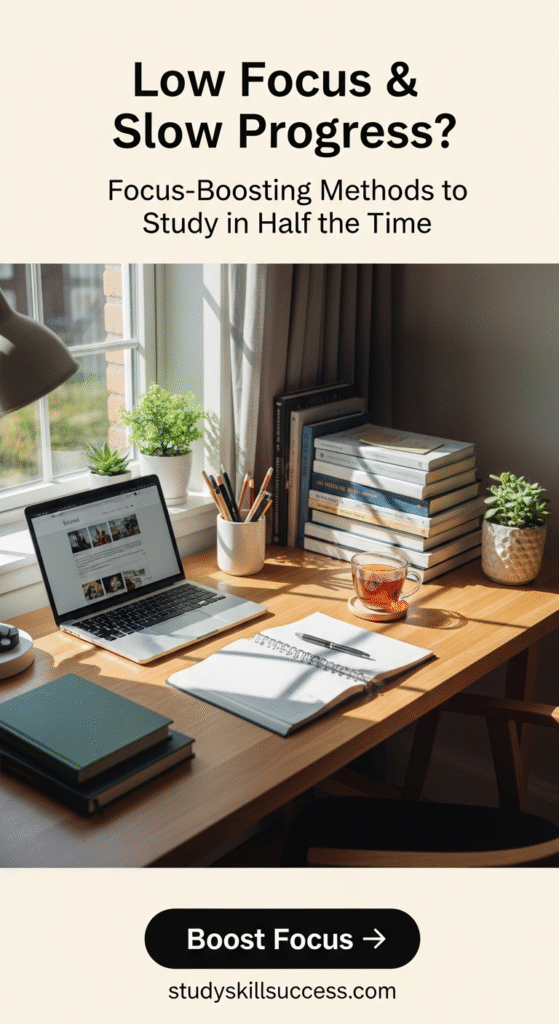
Common Focus Killers
Mobile phone
Messy desk
Multitasking
No routine
Nuclear Kill Switches
Phone on airplane mode, kept outside room
Desk rule: Book, pen, water only
One-task declaration before study
2-Hour Diamond Focus Formula
Preparation (5 min)
Box breathing
Desk reset
Execution (110 min)
52 min deep work
8 min break
52 min deep work
Closure (5 min)
Progress tick
Tomorrow’s top priority
Focus Multipliers
Morning study (6–7 AM)
Mint gum for alertness
Single color stationery
Progress streak calendar
Accountability partner
Complete 3-Hour Fast Study Daily Blueprint
6:00–7:00 AM: Power Hour
9:00–11:15 AM: Main session
7:00–8:00 PM: Review + flashcards
Brain Fuel
Pre-study: Coffee + nuts
Mid-study: Green tea
Post-study: Banana + milk
Water: 3–3.5 liters
Sleep: 7–8 hours
Free Tools
Anki / Quizlet
Forest app
White noise audio
Google Keep
Final Reality Check
Fast studying is not cheating or shortcuts. It is using your brain the way it is designed to learn. Three focused hours with the right methods are more powerful than eight distracted hours.
If you follow this system consistently, you will:
Finish syllabus early
Remember more with less effort
Reduce stress and panic
Improve marks significantly
Print this guide, follow it daily, and track progress honestly. Slow learner to fast performer — this transformation is guaranteed with execution.
Study smart. Stay consistent. Results will follow.